GTA Market Report · Vol. 08 / 2026GTA Real Estate Market Watch, August 2026 — Supply Tightens Further Across York Region & TorontoBy Gagan Gill, REALTOR® with Royal Canadian

Dated: June 23 2026
Views: 339
GTA Buyer Education
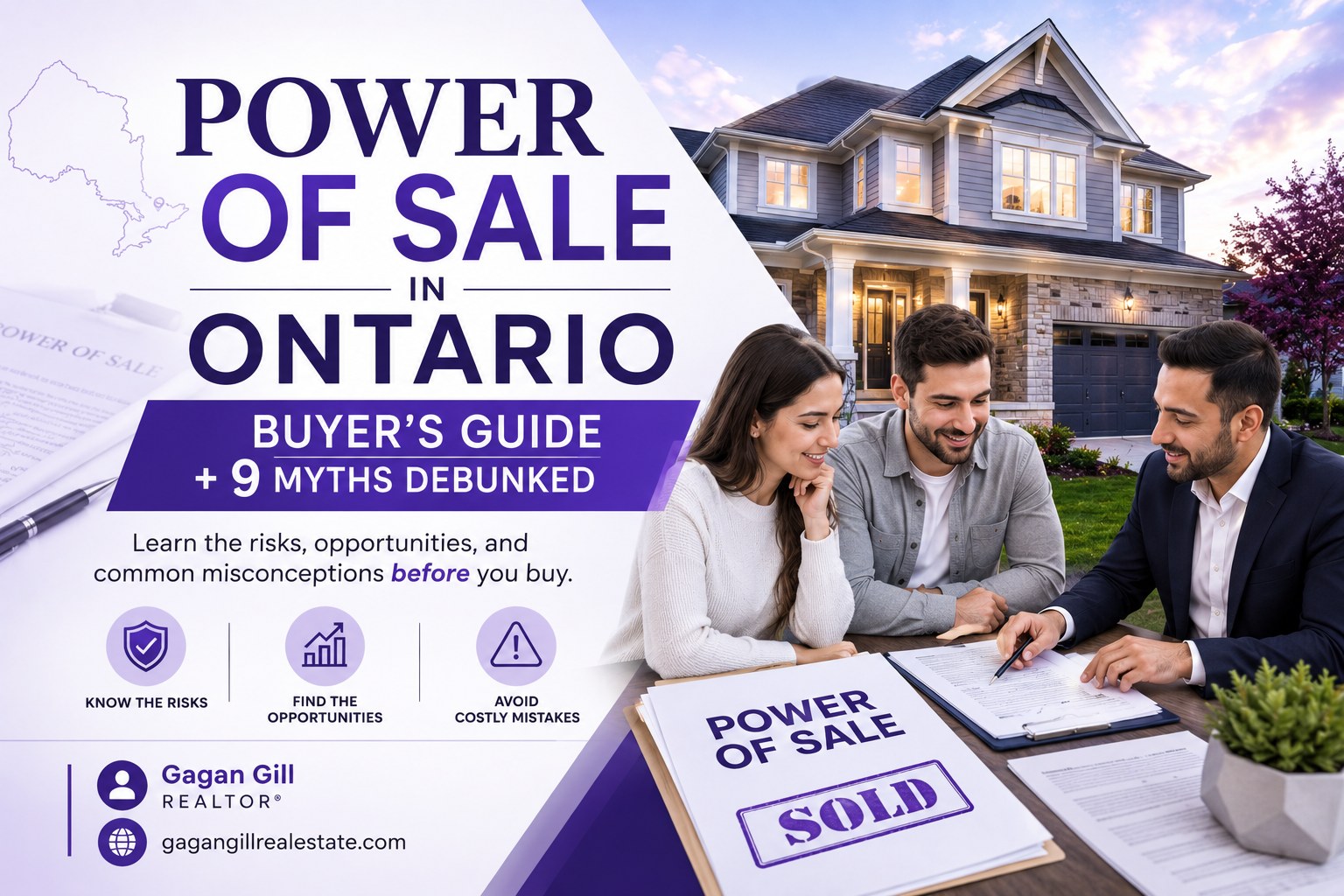
A complete, plain-English guide to the legal process, 9 common myths corrected, and how to buy a power of sale property the right way — in Markham, York Region, and across the GTA.
Jump to a section
A power of sale is a clause built into most Ontario mortgage contracts. It gives a lender the right to sell a property if the borrower defaults — typically by missing mortgage payments — without first going through a full court process. It is governed by Ontario's Mortgages Act (R.S.O. 1990, c. M.40), which sets out strict notice periods, timelines, and protections for both the lender and the homeowner.
Here is what actually happens, in order of importance for a buyer:
Every power of sale in Ontario follows the same legally mandated sequence. Knowing this timeline helps buyers understand exactly where a listed property is in the process — and helps anyone facing default understand how much time they realistically have.
These three terms get used interchangeably online — and almost never correctly. Here's the real breakdown:
| Term | Who holds title? | Court involved? | Who gets surplus funds? |
|---|---|---|---|
| Power of Sale | Homeowner, until closing | Generally no | Homeowner |
| Foreclosure | Transfers to lender | Yes — full judicial process | Lender keeps everything |
| Distressed Sale | Homeowner (voluntary sale) | No | Homeowner — it's their own sale |
Foreclosure is rare in Ontario specifically because power of sale is faster and cheaper for lenders. A "distressed sale" simply means a homeowner is selling under financial pressure — it isn't a legal designation at all, and it's often confused with power of sale in casual conversation or even in listings.
This is where most buyers — and even some agents — get it wrong. Here are the misconceptions I hear most often, corrected one at a time.
Is buying a power of sale property risky?
Not inherently riskier than any other resale, as long as you do a proper inspection, work with an agent and lawyer familiar with these transactions, and go in understanding the as-is terms. The risk comes from skipping due diligence, not from the power of sale process itself.
Do power of sale homes sell below market value?
Not by law — Ontario lenders are required to make reasonable efforts to achieve fair market value. Any savings tend to come from condition, timeline pressure, or limited marketing exposure rather than a built-in discount.
Can the previous homeowner come back and reclaim the property after I buy it?
Once the sale has closed and the lender has properly followed the notice and redemption requirements under the Mortgages Act, the buyer's title is generally secure. This is exactly why proper legal review during the transaction matters.
How long does a power of sale take from default to listing?
At minimum, roughly 50 days from default to the end of the redemption period (15-day wait plus a 35-day redemption period), before the lender can even begin marketing the property. In practice, it often takes longer.
Is power of sale only an Ontario thing?
No — but the specific rules in this guide apply to Ontario under the Mortgages Act. Other provinces and countries (including foreclosure-based U.S. states) handle mortgage default differently, so always confirm the rules for your specific location.
Whether you're a first-time buyer curious about a listing you saw, or you want a second set of eyes before you make an offer, I can walk you through exactly what to look for — and what to avoid.
📅 Book a Free Consultation ⭐ Read Client TestimonialsOr reach me directly at 647-557-3135

I’m Gagan Gill, a Realtor® with Royal Canadian Realty, helping first-time home buyers, move-up families, and sellers make confident real estate decisions across the Greater Toronto Area&mdas....
GTA Market Report · Vol. 08 / 2026GTA Real Estate Market Watch, August 2026 — Supply Tightens Further Across York Region & TorontoBy Gagan Gill, REALTOR® with Royal Canadian
GTA Rate WatchBank of Canada Holds Rates Again: What Wednesday's Announcement Means for GTA Homeowners and BuyersSeptember 2, 2026 | 6 min read | Gagan Gill, REALTOR®The
GTA Home Maintenance GuideBack-to-School Home Maintenance Checklist for GTA Homeowners & First-Time BuyersSeptember isn't just the start of the school year — it's the start of your home's
GTA Market Report · Vol. 07 / 2026GTA Real Estate Market Watch, July 2026 — Market Conditions Tighten Across York Region & TorontoBy Gagan Gill, REALTOR® with Royal Canadian
 Toronto Real Estate Board (TRREB); All information deemed reliable but not guaranteed. All properties are subject to prior sale, change or withdrawal. Neither listing broker(s) or information provider(s) shall be responsible for any typographical errors, misinformation, misprints and shall be held totally harmless. Listing(s) information is provided for consumer's personal, non-commercial use and may not be used for any purpose other than to identify prospective properties consumers may be interested
in purchasing. The data relating to real estate for sale on this website comes in part from the Internet Data Exchange program of the Multiple Listing Service. Real estate listings held by brokerage firms other than Royal Canadian Realty, Brokerage, Markham may be marked with the Internet Data Exchange logo and detailed information about those properties will include the name of the listing broker(s) when required by the MLS. Copyright ©2026 All rights reserved.
Last Updated: September 23, 2026 3:03 AM UTC
Show More...
Toronto Real Estate Board (TRREB); All information deemed reliable but not guaranteed. All properties are subject to prior sale, change or withdrawal. Neither listing broker(s) or information provider(s) shall be responsible for any typographical errors, misinformation, misprints and shall be held totally harmless. Listing(s) information is provided for consumer's personal, non-commercial use and may not be used for any purpose other than to identify prospective properties consumers may be interested
in purchasing. The data relating to real estate for sale on this website comes in part from the Internet Data Exchange program of the Multiple Listing Service. Real estate listings held by brokerage firms other than Royal Canadian Realty, Brokerage, Markham may be marked with the Internet Data Exchange logo and detailed information about those properties will include the name of the listing broker(s) when required by the MLS. Copyright ©2026 All rights reserved.
Last Updated: September 23, 2026 3:03 AM UTC
Show More...

The listing data displayed is deemed reliable but is not guaranteed accurate by CREA®. Data last updated on September 23, 2026 3:46 AM UTC The trademarks REALTOR®, REALTORS®; and the REALTOR® logo are controlled by The Canadian Real Estate Association (CREA®) and identify real estate professionals who are members of CREA®. Used under license. The trademarks MLS®, Multiple Listing Service® and the associated logos are owned by The Canadian Real Estate Association (CREA®) and identify the quality of services provided by real estate professionals who are members of CREA®. Used under license.
Show More...